Classical Guitar Pro
10 Habits of
Deliberate Practice
A free video lesson and a written companion you can work through in a single sitting.
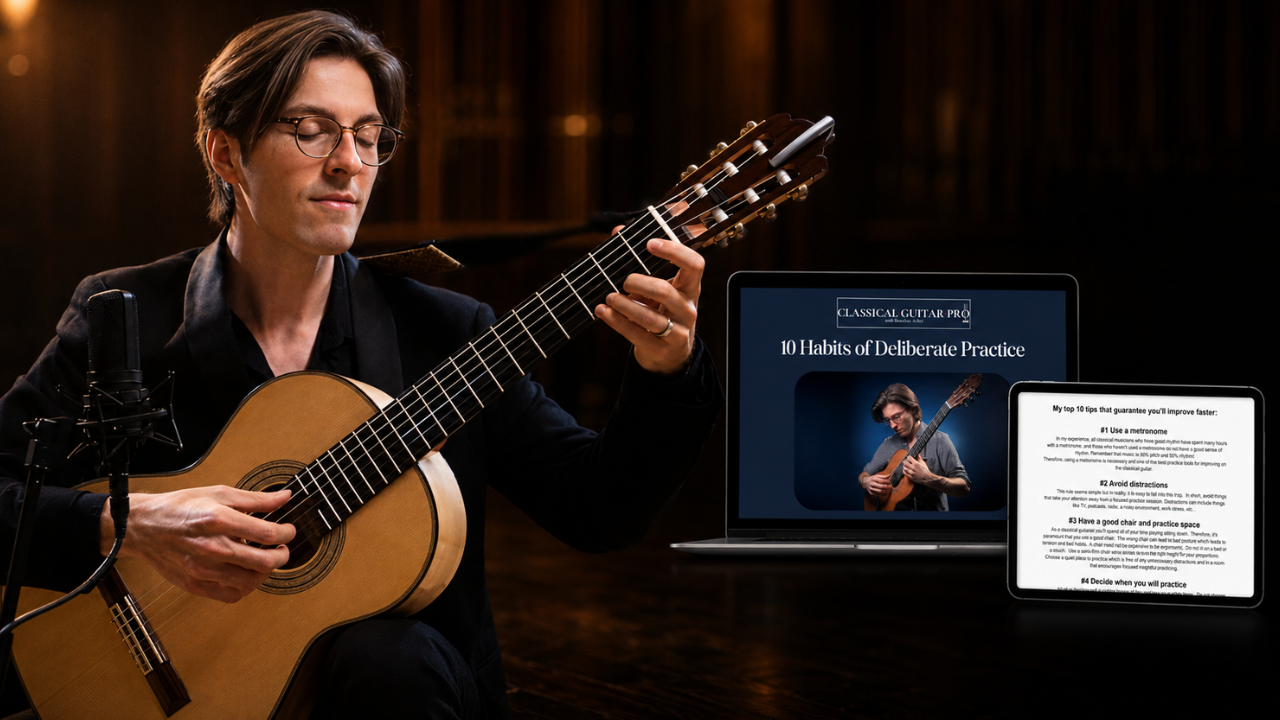
Your video lesson and PDF arrive immediately.
Only your email address is required.
You May Not Need More Practice.You Need a Better Method.
You can spend months with the same piece and still find the same passages refusing to improve.
The problem is rarely effort.
The problem is that most musicians spend far more time performing a piece than practicing it.
The mode we use in front of an audience. We continue through our errors, because stopping to correct them is disturbing for the listener. Used in a concert, it is exactly right.
Something else entirely. We stop. We isolate the precise location of the problem. We slow it to a tempo at which it becomes easy. We correct it deliberately, and only then do we return it to its place in the music.
Both modes are necessary. The difficulty is that almost no one is taught the difference, and so most of us run Performance Mode at home, alone, for years, and call it practice.
If nobody taught you that distinction, you are not lazy, you are not untalented, and you are not too old. You were simply never given the method.
There is a further consequence, and it is quieter than the first.
Without a method, you also have no way to observe what has changed. Your progress becomes invisible to you. Invisible progress feels precisely like no progress at all, which is why so many capable musicians conclude that they have stopped improving, when in truth they have only stopped being able to see it.
I was not always systematic in my own practice. Learning to work this way changed the value of every hour I spent with the instrument.
One Focused Lesson.A Method You Can Keep Using.
You will receive two resources, designed to be used together.
The video lesson, How to Practice, is my direct instruction on the habits that produce deliberate and productive work with the guitar. You can watch it in one sitting and begin applying the method the same evening.
The written companion is a reference to keep beside your music. It contains the distinction between Practice Mode and Performance Mode, and it contains the four step process I use whenever a passage refuses to improve.
That process is the practical center of the entire method. You diagnose the exact location of the problem. You repeat that location at a tempo slow enough that it becomes easy. You return it to its context. If it holds, you are finished, and if it does not, you begin again. It is a method rather than a suggestion, and it works on any passage, in any piece, at any level.
The lesson contains ten habits in total. Four of them are these. You will learn why I practice in front of a mirror, what I write in my own practice log, why I continue to work from annotated scores long after a piece is memorized, and how a goal small enough to complete in one sitting makes progress possible to see.
The method asks for thirty minutes a day, five days a week. That is the minimum I recommend, and it is sufficient to produce a substantial improvement. The question was never how many hours you have available. The question is what happens inside them.
These are not abstract principles. They are the working habits I continue to use in my own practice, and they are intended to give structure and purpose to the time you already spend with the instrument.
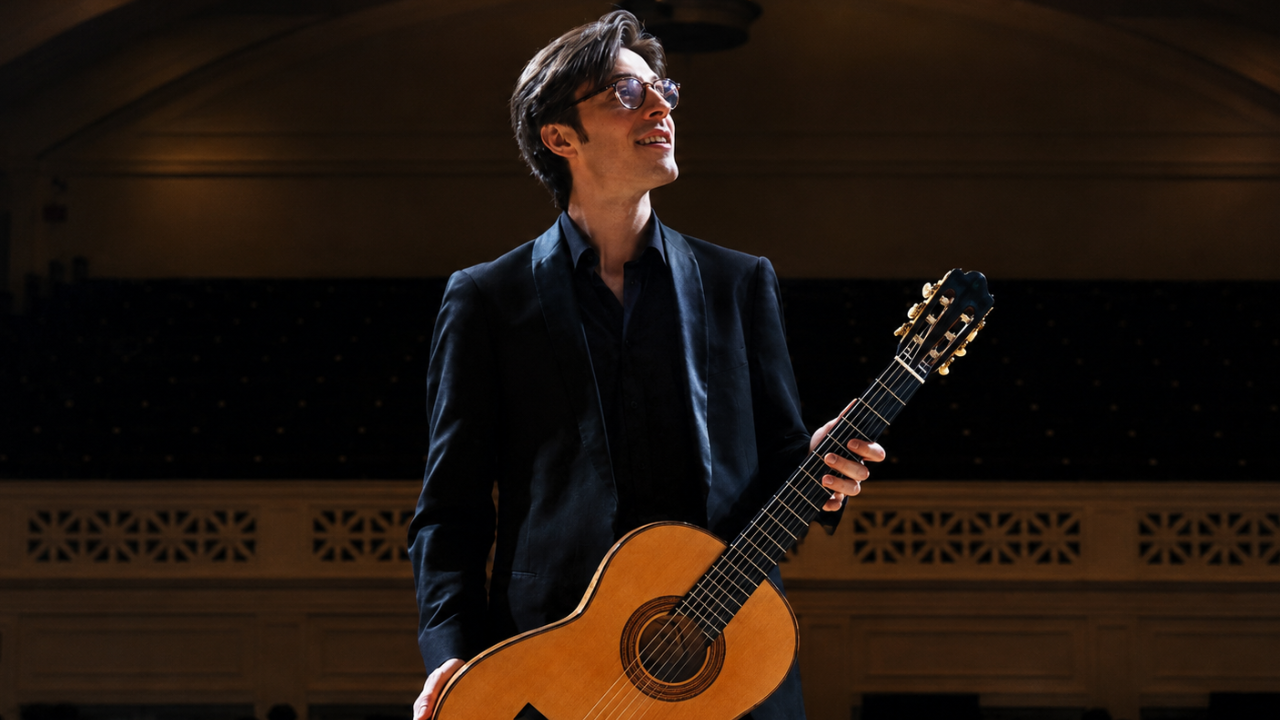
About Brandon Acker
Brandon Acker is a classical guitarist, educator, and specialist in historical plucked instruments, including the lute, theorbo, and Baroque guitar. He holds degrees in classical guitar from DePaul University and Northwestern University, and he has performed internationally with distinguished orchestras and early music ensembles.
The principles in this lesson are not habits I reserve for my students. They remain part of my own practice, and beginning a practice log fundamentally changed the way I work with the instrument.
Receive the Lesson andWritten Companion
I teach because I believe that useful instruction should be shared. I would also like to send you more of it.
Enter your email address to receive the How to Practice video lesson and its written companion.
Your video lesson and PDF arrive immediately.
Only your email address is required.